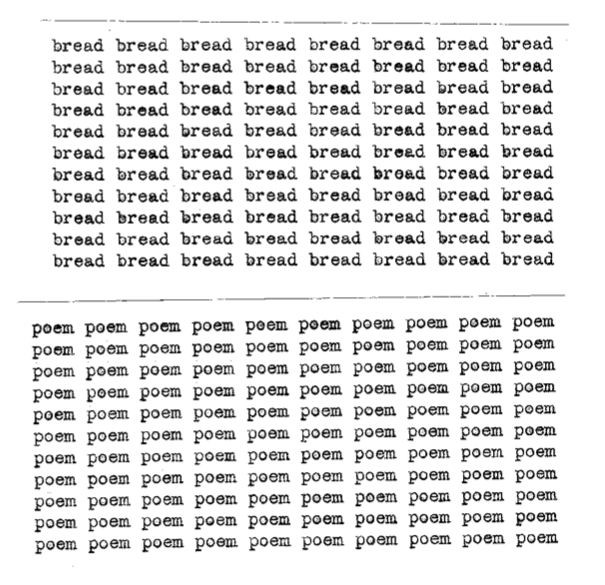
The Bread Poems project involves us (Brandon De La Cruz, Graison Gill, and David Andrews) making bread and the artists of Iowa City “paying” for this bread with small works of heartfelt art.
Our hope is that in your art you can engage with the crafts which leaven a loaf of bread — baking, milling, farming (harvesting, threshing, combining, irrigating), biology (photosynthesis, vernalization, rooting, nutrient-uptake, gestation), grain-growing, ecology, transport, harvesting, fermentation, weather patterns (rainfall, soil composition), seed variety, breeding and grain selection, yield (depending on rainfall and weather patterns), and obviously slicing, toasting, tearing, and enjoying with your loved ones.
The idea is that you are becoming a part of the life cycle of the bread by creating your art “payment.” In that vein, in the case that it would be helpful to your art, we want to share some more details about the bread with you. These particular loaves are made with 100% stone-milled whole grain flour. The grain for these loaves comes from Janie's Mill in Ashkum, Illinois and from Meadowlark Farm in Ridgeway, Wisconsin. Something that might feel generative to you is that everything the earth put into the grain is preserved during the stone-milling process. By milling the whole grain you are gaining access to more flavor and more of the Earth.
A fun fact: A tablespoon of healthy soil and a tablespoon of whole grain sourdough starter both contain between 300 million and 3 billion individual bacteria. Every time we create the starter for these loaves of bread we are cultivating many tablespoons of starter and far more bacteria in each batch than the number of individuals alive on earth today. These bacteria are part of the life force of the bread. Upon baking the bread we kill these microorganisms at a high temperature in order for the bread to become a part of your life. It is a living organism and then it dies in the oven and it can become a part of your one wild and precious life.
Making bread is a craft deeply related to hands. Each loaf is shaped by hand and you could even use the term “hand-hewn.” This is not so different from the physicality of holding a pen or pencil and writing in a notebook. As you write and think, please connect, if you wish, to this sense of writing as a physical and embodied act. Think about writing along the lines of Frank O’Hara’s idea of "playing the typewriter."
For this loaf of bread you should take it home and leave it on the counter un-covered or with a towel or brown bag and just slice of pieces as you desire. You could even tear pieces off. When “paying” for the bread with your piece of art please hand your art to Brandon De La Cruz or drop it in his wire basket in Dey House.
In case you are interested in some more specificity of the bread-making process, please read on: The grains begin fermentation on Night One with the levain. The grains are then fermented together on Day Two afternoon and are together in a bulk fermentation until 5 p.m. on Day Two evening. The loaves are divided at David's house and then put into the fridge for fifteen hours. We heat up the oven on Day Three at five A.M., the stones get ripping hot, and we then load all of the loaves into the oven from bottom to top. Once the loaves are all settled in on the hot stones we use a garden sprayer to steam the loaves and shut the finicky door with a swift knee to the chest of the oven. The loaves then steam and bake for approximately 30 minutes in a closed environment, and then we poke two small vents to release the steam. They then finish baking to a burnished, mahogany color. The loaves finally rest outside of the oven and are ferried to Dey House at approximately 2 p.m. on Mondays. Alternate schedules may be utilized in order to provide bread to different groups of artists. 2 p.m. falls before the 2:30 p.m. Poetry Workshops, but our goal is to facilitate pick-ups for different groups of writers and artists as well.